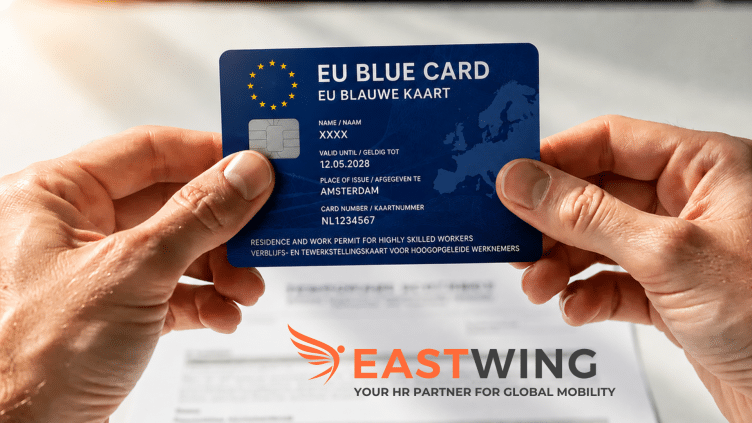

There are several options available for highly skilled employees from outside the EU who wish to work in the Netherlands. The two main options are the EU Blue Card and the residence permit under the Dutch Highly Skilled Migrant (HSM) scheme. Both options have their own requirements, benefits, and procedures.
Choosing between these options can be complex. Many companies consider the national HSM scheme more attractive because of the greater flexibility in salary thresholds and the faster and simpler procedures. However, the rules surrounding the EU Blue Card have recently been relaxed and are now much more aligned with the HSM scheme, which may make this type of residence permit a more attractive option. In practice, we often see that employees prefer the EU Blue Card because of the various advantages it offers.
What are the most important differences between an EU Blue Card and a Highly Skilled Migrant permit?
The main difference lies in the requirements and possibilities. The EU Blue Card combines high salary thresholds with educational requirements, whereas the Dutch HSM scheme focuses primarily on salary and market conformity.
For the EU Blue Card, the employee must earn at least €5,942 gross per month (excluding holiday allowance) in 2026 and hold a completed bachelor’s or master’s degree that meets Dutch standards. For recent graduates, a reduced salary threshold of €4,754 gross per month may apply under certain conditions.
The Dutch HSM scheme applies the same standard salary threshold (€5,942 gross per month excluding holiday allowance) but also offers two lower salary thresholds (€4,357 gross per month for highly skilled migrants under the age of 30 and €3,122 for recent graduates).
In addition, the HSM scheme requires the employer to first become a recognised sponsor. This involves government fees of €5,080 (in 2026) and may be challenging for start-ups. The EU Blue Card does not require recognised sponsor status for the employer.
Who is the EU Blue Card intended for and what are the requirements?
The EU Blue Card is specifically intended for highly skilled workers from outside the EU who can help meet labour market demands within EU Member States and strengthen the competitiveness of the EU.
To qualify for an EU Blue Card in the Netherlands, the employee must meet three main requirements:
- An employment contract for at least six months.
- A gross monthly salary of at least €5,942 (excluding holiday allowance), or €4,754 gross for recent graduates. These amounts apply in 2026.
- A completed bachelor’s or master’s degree that meets Dutch standards. If no diploma can be provided, an alternative route may apply whereby five years of relevant work experience can be sufficient under certain conditions (or three years for IT professionals).
The diploma must be evaluated by Nuffic in the Netherlands to determine equivalence with the Dutch education system.
What advantages does an EU Blue Card offer compared to a Highly Skilled Migrant permit?
The main advantage of the EU Blue Card is the possibility to work in other EU Member States under specific conditions. Holders may work in other countries if the legislation of that country grants direct access to the labour market. However, the EU Blue Card is not an EU-wide residence permit comparable to the American Green Card. Holders must still submit a separate application in each new country if they wish to relocate within the EU.
For permanent residence or citizenship purposes, EU Blue Card holders may combine periods of residence in different Member States. The requirements are five years of legal and uninterrupted residence within the EU as an EU Blue Card holder and two years of legal and uninterrupted residence as an EU Blue Card holder in the Member State where the long-term residence application is submitted.
How long does the application process take for an EU Blue Card versus a Highly Skilled Migrant permit?
For an EU Blue Card, the application process takes approximately 90 days for non-recognised sponsors or 30 days for recognised sponsors.
The Dutch HSM scheme generally has significantly shorter processing times. Recognised sponsors can often obtain a highly skilled migrant residence permit for their employees within two weeks.
The process for both type of residence permits does not differ upon decision of the IND. Upon arrival in the Netherlands, foreign employees must collect their residence permit from the IND, register with the municipality, obtain a citizen service number (BSN), and, depending on their nationality, undergo a mandatory tuberculosis test. For Filipino employees, an Overseas Employment Certificate (OEC) is required. This may extend the process by several months, although with proper guidance it can often be completed within three weeks. This process in the Philippines is separate from the residence permit application with the IND, but it can significantly delay the overall relocation timeline.\
When should you choose an EU Blue Card instead of a Highly Skilled Migrant permit?
The EU Blue Card is particularly attractive for employees who intend to work in multiple EU countries in the long term. Please note: a residence or work permit is almost always required per country. Furthermore, the EU Blue Card may also be attractive for startups that experience difficulties obtaining recognized sponsor status, as recognized sponsorship is not required for this type of residence permit application. However, the salary thresholds and diploma recognition requirements often make it a less attractive option.
In most other cases, the Dutch HSM scheme is generally more beneficial, at least from the employer’s perspective. It offers multiple salary thresholds, faster procedures for recognised sponsors, and simpler documentation requirements.
How Eastwing supports EU Blue Card applications
We understand that choosing between an EU Blue Card and the HSM scheme can be complex. Our experience with both procedures helps companies make the right choice for their specific situation.
We provide support with:
- Assessing which permit best suits your company and employee
- Guidance on diploma recognition through Nuffic for EU Blue Card applications
- Assistance with obtaining recognised sponsor status for the HSM scheme
- Full application support, including document preparation
- Assistance with municipal registration, BSN applications, and other formalities
With our practical approach, we translate complex immigration legislation into clear and manageable steps, allowing you to focus on your business and international mobility policies while we handle the procedures.
Do you have additional questions or need assistance? We would be happy to help. Feel free to contact us at service@eastwing.nl.