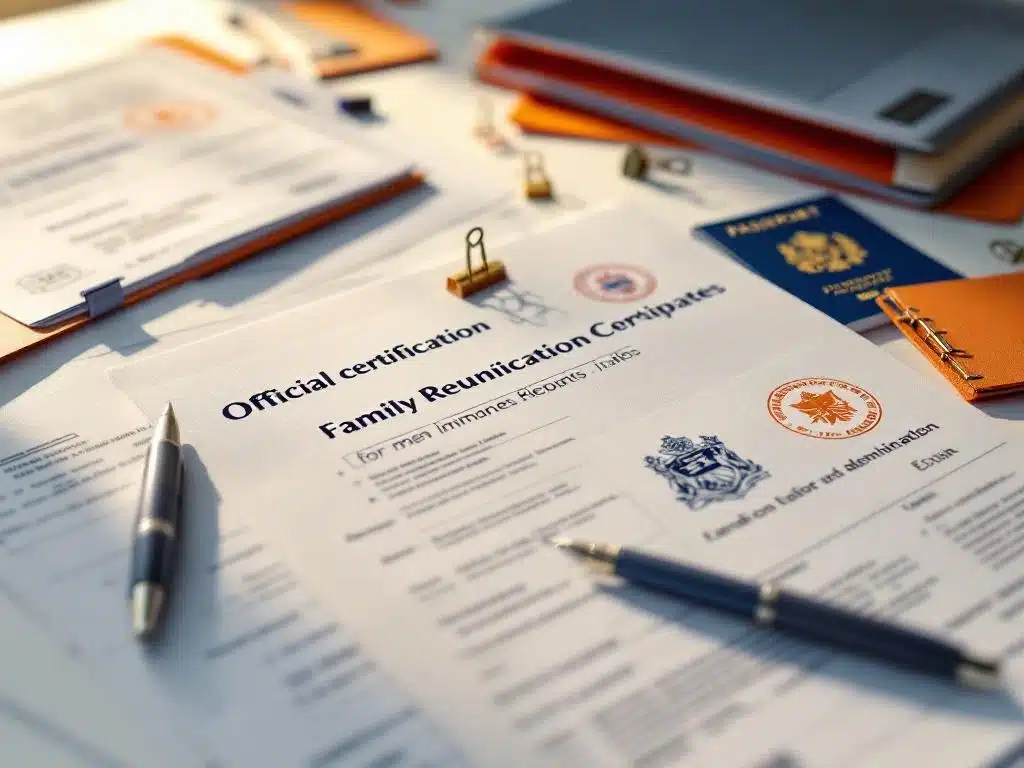

For a successful family reunification in the Netherlands, you need several official documents. The most important ones are identity documents such as a valid passport, proof of your relationship such as a marriage certificate or cohabitation agreement, and financial documents such as pay slips and bank statements. You also need to demonstrate that you meet the income requirements and have adequate housing. Gathering all family reunification documents often takes 2–4 months, especially if you need to request papers from abroad.
Which documents are required for family reunification?
For your family reunification application with the IND, you need several categories of documents. Together, these documents form your family reunification checklist and determine whether your application is processed successfully.
Identity documents
You need valid identity documents for everyone involved. This means a valid passport for yourself and your partner or children coming to the Netherlands. Make sure passports are still valid for at least 6 months at the time of application.
You must also include a copy of your Dutch residence permit or Dutch identity card as proof that you are lawfully residing in the Netherlands.
Proving relationship and family ties
For partners, you need an official marriage certificate, or proof of a registered partnership. If you are cohabiting without being married, you must demonstrate that you have had a lasting relationship for at least 1 year.
For children, birth certificates are required to prove the family relationship. For adopted children, you also include the adoption certificate.
Financial documents
The family reunification requirements include strict income criteria. You must prove that you have sufficient income to support your family without relying on social assistance.
- Pay slips from the last 3 months
- Annual income statement or IB60 form from the Tax Authority
- Employment contract or employer’s declaration
- Bank statements from the last 3 months
Proof of housing
You must demonstrate that you have sufficient living space. You do this with an extract from the Personal Records Database (BRP) and a declaration from your landlord or a deed of ownership.
How do you obtain missing documents from abroad?
Requesting documents from the country of origin can take time. You often have to deal with various authorities and procedures that differ by country.
Contacting local authorities
Start by contacting the civil registry in the country where the documents were issued. For marriage certificates and birth certificates, this is usually the municipality where the event took place.
Ask directly about the procedure and costs. Some countries offer online application options, while others require a written request or a personal visit.
Apostille and legalisation
Foreign documents often need to be legalised before they are valid in the Netherlands. For countries that have signed the Apostille Convention, an apostille is sufficient. For other countries, a legalisation procedure via the Dutch consulate is required.
This apostille must be obtained in the country where the document was issued, before you send it to the Netherlands.
Sworn translations
All foreign documents must be translated by a sworn translator who is recognised in the Netherlands. These translations are official and are accepted by the IND.
Make sure you arrange the apostille first and only then have the document translated. The translator must translate both the original document and the apostille.
Cooperation with embassies
Dutch embassies and consulates can help you obtain documents. They often have contacts with local authorities and can advise you on the fastest procedure.
When there are difficulties obtaining documents, the embassy can sometimes issue a statement explaining the absence of certain documents.
Common mistakes in document preparation
Many applications for a family reunification residence permit are delayed due to avoidable mistakes. These mistakes cost time and sometimes extra money.
Submitting expired documents
A common mistake is submitting documents that are too old. The IND generally only accepts financial documents that are no more than 3 months old.
Always check the validity of all documents just before submitting your application. Plan your document collection so that everything is current at the time of submission.
Missing apostilles or translations
Foreign documents without proper legalisation or translation are not accepted. This leads to delays because you have to supply new documents.
Create a checklist of all foreign documents and verify that each document has an apostille and has been correctly translated by a sworn translator.
Incomplete financial evidence
Being unable to demonstrate sufficient income is a primary reason for rejection. Make sure you document all sources of income and that your income exceeds the set standards.
With fluctuating income, it is advisable to provide additional evidence, such as an accountant’s statement or extensive bank statements.
Errors in Dutch documents
Dutch documents can also cause problems. Make sure your registration with the municipality is correct and that all details are consistent across different documents.
Check that your name and date of birth are spelled consistently in all documents. Minor discrepancies can raise questions.
Timeline and planning for document collection
A realistic plan helps you submit your family reunification Netherlands application on time. The total lead time depends on various factors.
Dutch documents (1–2 weeks)
Dutch documents are usually quick to obtain. An extract from the BRP can often be obtained the same day at the municipality. Bank statements and pay slips you probably already have at hand.
Allow 1–2 weeks for collecting all Dutch documents, including any employer’s declarations.
Foreign documents (6–12 weeks)
Documents from abroad take more time. Taking into account applications, apostilles, and postage, this process often takes 6–12 weeks.
Start this as early as possible. Some countries have longer waiting times, especially for consular services.
Translations (1–2 weeks)
Sworn translations usually take 1–2 weeks, depending on how busy the translator is. Plan this after you have received all apostilled documents.
Some translators have longer waiting times, especially for less common languages. Enquire about the lead time in advance.
Total planning (2–4 months)
For a complete family reunification document application, it is best to allow 2–4 months. This gives you enough time to resolve any issues without stress.
Create a timeline with all the steps and account for possible delays. Start with the documents that take the longest, such as foreign certificates.
Good planning prevents documents from expiring before your application is complete. This saves time and costs in your family reunification IND procedure.
Gathering all the required documents for family reunification takes time and careful planning. With the right preparation and a realistic timeline, you significantly increase the chances of a successful application. At Eastwing, we help companies and their international employees with the complete immigration and residence permit process, from document preparation through to the final residence permit. We ensure that all paperwork is correct and submitted on time, so you can focus on what really matters. For personal advice, you are always welcome to contact us.