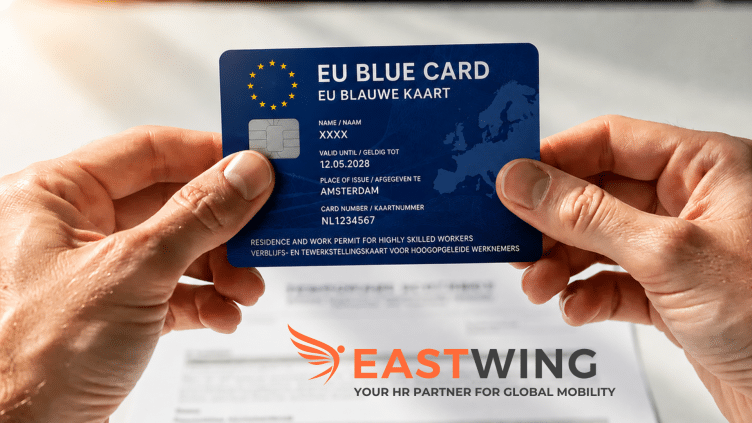

The EU Blue Card offers highly skilled professionals from countries outside the EU access to the Dutch labor market. You qualify if you have a higher education degree, an employment contract with a salary of at least €5,688 per month (2025) with a Dutch employer. Non-EU citizens from all countries can apply, but you can also leave this to your employer. The most common reasons for rejection are incomplete documentation and incorrect timing of the application.
What exactly is the EU Blue Card?
The EU Blue Card is a special residence and work permit for highly skilled professionals who want to move to the Netherlands. This permit gives you the right to work and live in the Netherlands, with more benefits than a regular work permit.
The key difference from other work permits lies in the simplified procedure and additional rights. With a regular work permit, your employer must first demonstrate that no EU citizen is available for the position. This labor market test is waived with the Blue Card. Your family can also more easily join you in the Netherlands.
For employers, the Blue Card is attractive because the process is faster. They can attract international talent more easily without long waiting times. This helps companies that quickly need qualified staff for specialist positions.
What educational requirements apply for the EU Blue Card?
You need at least a higher education degree comparable to a Dutch HBO or university degree. This means a course of study of at least three years after secondary education. Your degree must be recognized by the Dutch authorities.
Degree recognition is handled by various organizations, depending on your profession. For regulated professions such as doctor, lawyer, or architect, you need a professional recognition. For non-regulated professions, you can request a degree assessment from the Information Centre for International Credentials (ICIO).
Foreign qualifications are assessed on level and content. The ICIO compares your degree with the Dutch education system. They look at the duration of the study, the entry requirements, and the academic level. This process usually takes 4 to 8 weeks.
Some countries have bilateral agreements with the Netherlands through which degrees are automatically recognized. For other countries, you must provide additional documentation, such as an apostille or translation by a sworn translator.
Salary and employment contract requirements for Blue Card applicants
The minimum salary for a Blue Card is €5,688 gross per month excluding holiday allowance in 2025. This amounts to nearly €74,000 per year. This amount is adjusted annually and is 1.5 times higher than the Dutch average salary.
Your employment contract must be for a minimum of six months and may not have been signed more than three months before your application. The contract must clearly state your position, salary, and employment conditions.
Your employer must be a recognized sponsor with the IND. This means the company is officially recognized to hire foreign employees. Employers must meet strict requirements regarding reliability and financial stability. If your employer is not a recognized sponsor, the application for an EU Blue Card can still be submitted. However, keep in mind longer processing times and a greater number of documents that need to be provided.
The salary is calculated based on your gross monthly salary, including holiday allowance and any structural supplements. One-time bonuses or expense reimbursements do not count. If you work part-time, you must still meet the minimum salary standard, without pro-rating.
Employers are obligated to pay your salary on time and maintain correct payroll records. They must also ensure a proper workplace and compliance with all Dutch labor regulations.
Which countries and nationalities are eligible?
All non-EU citizens can apply for a Blue Card, regardless of their nationality. This applies to people from Africa, Asia, North and South America, and other countries outside the European Union. EU citizens do not need a Blue Card because they are free to work in the Netherlands.
Citizens from Norway, Iceland, Liechtenstein, and Switzerland also fall outside the Blue Card scheme. These countries have special agreements with the EU through which their citizens have the same rights as EU citizens.
There are no restrictions by nationality, but some countries have longer processing times due to additional security checks. This applies especially to countries with political instability or where diplomatic relations are complex.
Refugees and people with international protection status can also apply for a Blue Card if they meet all other requirements. Their status as a protected person does not stand in the way of a Blue Card application.
Some countries have bilateral agreements with the Netherlands that can speed up the application process. These agreements mainly relate to degree recognition and not to the Blue Card procedure itself.
Avoiding common mistakes in Blue Card applications
The most common reason for rejection is incomplete documentation. Make sure all documents are complete, recently dated, and correctly translated. Missing signatures or incorrect forms automatically lead to delays or rejection.
Timing is important with Blue Card applications. Do not submit your application too early, but also not too late. The ideal moment is 2-3 months before your planned start date. Applications submitted too early may expire before you start working.
Many applicants make mistakes when calculating their salary. Only count structural salary components and do not forget holiday allowance. Expense reimbursements and one-time bonuses do not count toward the minimum salary.
Degree recognition is often underestimated. Start this process well in advance as it can take 4-8 weeks. Without valid degree recognition, you cannot apply for a Blue Card, regardless of your other qualifications.
Check whether your employer is actually a recognized sponsor with the IND. Many companies think they are recognized but have let their status lapse. An employer without valid recognition can still submit a Blue Card application, but processing times are longer. Keep that in mind.
Ensure correct translations of all your documents. Only use sworn translators and verify that all information is correct. Incorrect translations often lead to confusion and delays in the procedure.
We help companies daily with navigating these complex immigration procedures. Our experience shows that good preparation and timely application significantly increase the chance of success. By avoiding these common mistakes, you increase the chance of a smooth Blue Card procedure. For personal advice about your situation, you can contact us.